How Much Does It Cost to Rent an LED Screen for a Trade Show in Amsterdam?
By the Amsterdam Video Wall Rental Team · Updated November 2026
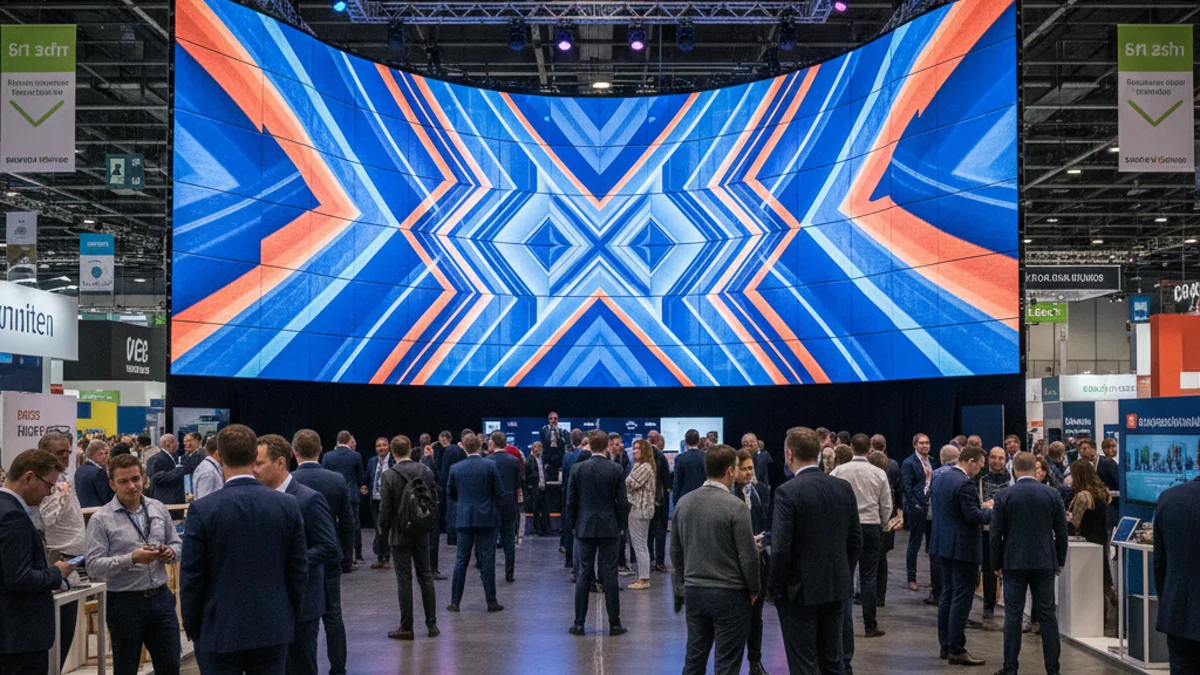
Renting an LED screen for an Amsterdam trade show usually costs between roughly €400 and €1,200 per day for a standard indoor wall, and €2,200 or more per day once you add a large RAI Amsterdam build, rigging, crew and content support. The number moves with three things above all: the wall area in square metres, the pixel pitch, and how long the hall needs the screen. If you want the pricing method before the detail, our convention video wall rental page and this guide break it into the same line items a Dutch rental house will quote you.
Amsterdam is a busy, compact event city. Load-in windows are short, the good halls book early, and an unplanned power request on move-in day is where budgets quietly break. Quick answers before the detail:
- A 3 × 2 m indoor wall starts near €400 per day.
- A 5 × 2.5 m trade-show wall starts near €700 per day.
- A flown 8 m keynote wall starts near €1,200 per day.
- Crew, delivery and spares add roughly 40–60% to the bare wall rate.
What Actually Determines LED Screen Rental Cost in Amsterdam
Five factors drive the quote. Rank them before you talk to suppliers and you will spot a fair price at a glance.
- Total screen area. Cabinets build in 0.5 m steps, so you cannot order 5.3 m — only 5 m or 5.5 m. Area is the biggest single driver.
- Pixel pitch. A dense P1.9 wall costs more per square metre than a P3.9 wall because the modules are packed tighter and the processor load is higher.
- Rental duration. Day rates ease for longer hires. A four-day RAI Amsterdam show is cheaper per day than a one-off.
- Venue logistics. Dock height, door widths, freight-lift size and rigging rules all add labour and time.
- Crew and on-site support. A technician who stays for the show, and content playback support, are real line items, not free extras.
LED Screen Rental Amsterdam: Indoor, Outdoor and Trailer Options
Amsterdam buyers usually need one of three screen types. Picking the right one is half the cost control, because each is priced and delivered differently.
Indoor LED walls
Indoor walls run at roughly 800–1,200 nits, which suits a controlled-light hall such as the RAI or the Beurs van Berlage. They build in 0.5 m increments and are flown or floor-stacked depending on the stand. Indoor walls are the workhorse of trade-show stand design in the city.
Outdoor LED walls
Outdoor walls need far more brightness, often 5,000 nits or more, plus the right IP rating and cooling. They suit festivals, fan zones and canal-side activations rather than carpeted halls. Expect a heavier power and weather plan.
Mobile LED trailer screens
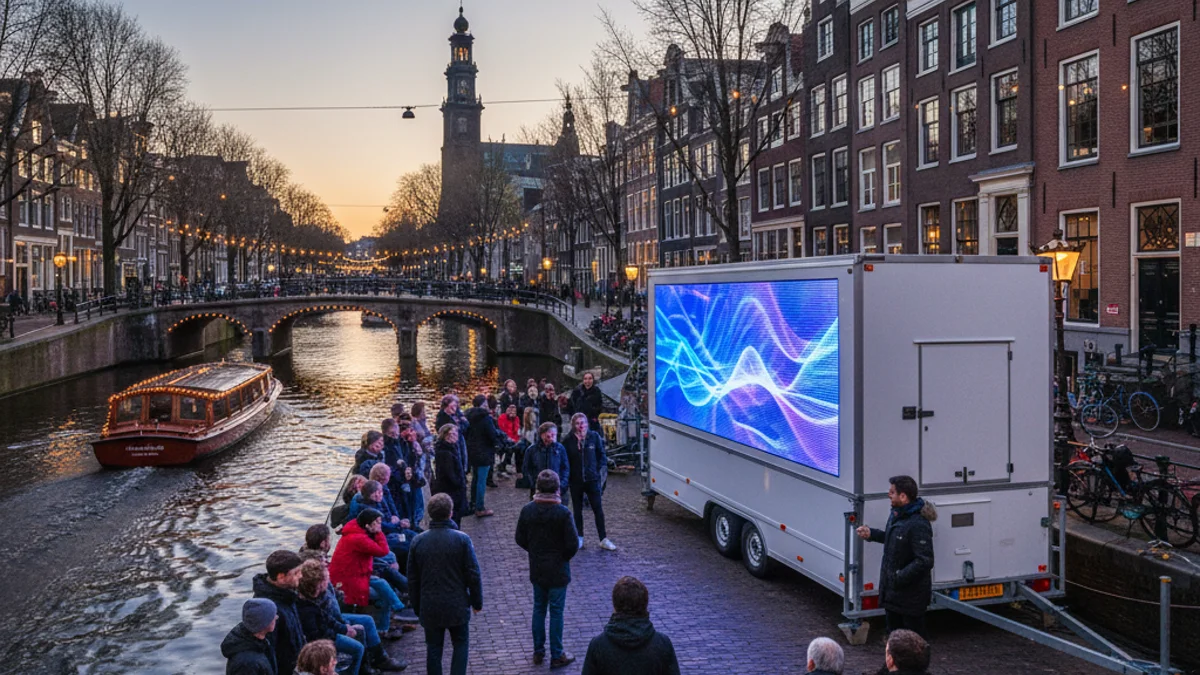
A trailer carries a screen of around 21 m² to a car park, a football pitch or a public square, arriving self-contained with its own power and control. Trailer hire is priced per day including the vehicle and driver, which suits a one-day activation better than a two-day hall build.
- Indoor wall: matches hall light, tight pitch, flown or floor-stacked.
- Outdoor wall: high brightness, IP-rated, weather plan required.
- Trailer: self-contained, arrives on wheels, best for one-day outdoor use.
Outdoor LED Walls for Amsterdam Activations
Outdoor LED walls in Amsterdam are a daylight problem first and a screen problem second. Direct sun washes out anything under about 5,000 nits, so the pitch and the brightness matter far more than the brand of cabinet. The Westergas area, the NDSM wharf and the Museumplein all host outdoor screens, and each brings a different power and rigging reality.
Two practical rules keep outdoor jobs on budget. First, size power to the full technical load — screen, lighting and audio — and order it with the event permit, not on the day. Second, plan for wind and rain: an outdoor wall needs ballast or ground anchors and a covered signal path.
- Confirm noise and finish-time rules for the site.
- Book a generator or a council power point with enough headroom.
- Carry a spare cabinet and a spare data run.
- Test brightness in daylight, not in the warehouse.
LED Wall Rental Paris, Amsterdam and Dusseldorf, Germany Compared
European buyers often price the same wall across several cities. Labour, venue rules and travel move the number more than the cabinets do, because the same pitch and size ship across borders. The table below compares how a 5 × 2.5 m P2.6 indoor wall is typically priced in three markets, using our 2026 estimates.
| City | Wall size & pitch | Indicative day rate (estimate) | Main cost driver |
|---|---|---|---|
| Amsterdam | 5 × 2.5 m, P2.6 | from €700/day | Short RAI load-in windows |
| Paris | 5 × 2.5 m, P2.6 | from €850/day | Strict venue and union rules |
| Düsseldorf | 5 × 2.5 m, P2.6 | from €780/day | Messe hall rigging and access |
The lesson is simple: budgets travel, but labour does not. LED wall rental in Paris, Düsseldorf or any large German hall usually costs more than the same screen in Amsterdam because of venue rules, not gear.
Unilumin LED Wall Rental in Amsterdam, the Netherlands
Unilumin is one of the cabinet brands common in Dutch rental stock, and it is a fair example of what to ask about in any quote. What matters is not the badge on the flight case but the pitch, the brightness, the processing and the spares behind it. When a supplier says “Unilumin LED wall rental in Amsterdam”, ask which pitch and which processor.
- Which pitch classes are in stock (P1.9, P2.6, P2.9, P3.9)?
- What brightness are the cabinets rated at?
- Which processor drives the wall, and is there a spare?
- How many spare cabinets travel with the order?
Brand-neutral questions get you a better wall than brand loyalty does. A well-specced cabinet from any major maker beats a poorly supported one from a name you recognise.
Curved LED Wall Barcelona and Amsterdam: When a Flat Wall Won’t Do
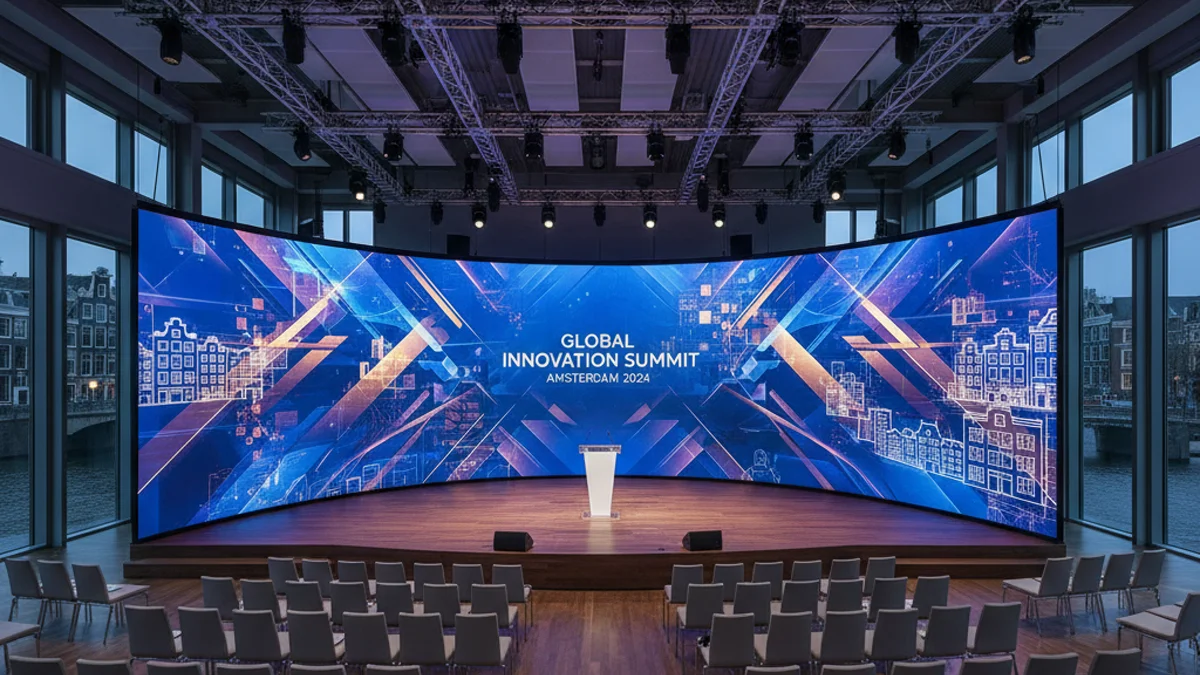
Curved LED walls bend inward or outward by a few degrees per cabinet, which lets a screen wrap a stage or follow an architectural curve. Amsterdam venues such as the Beurs van Berlage and the AFAS Live interior lend themselves to a gentle wrap; the same technique shows up on curved LED wall builds in Barcelona and elsewhere on the European circuit.
Curves cost more because the cabinets and the content both need care. The wall bends in small increments, and your content has to be authored for the curve or it looks warped at the edges. If a flat wall fits the sightlines, take the flat wall and spend the difference on pitch.
Which LED Wall Should You Rent for Your Event?
The right LED wall is a function of viewing distance, not budget alone. Match the pitch to how far the closest viewer sits, and the wall will look sharp without paying for pixels nobody can see.
- Small stand or breakout room, viewers 2–3 m away: P1.9 to P2.6.
- Standard trade-show wall, viewers 3–4 m away: P2.6 to P2.9.
- Large hall or stage, viewers 5 m and further: P3.9 to P4.8.
- Outdoor and long-throw: coarse pitch, very high brightness.
Indicative Amsterdam LED Screen Prices for 2026
Treat the figures below as a guide, not a quote. Every number is an estimate based on our own 2026 Amsterdam rates and assumes a ground-floor indoor install with standard power within 20 m of the wall.
| Configuration | Typical wall size | Pixel pitch | Indicative rate (estimate) | Best for |
|---|---|---|---|---|
| Small indoor backdrop | 3 × 2 m | P2.6 | from €400/day | Small stands, press corners |
| Standard trade-show wall | 5 × 2.5 m | P2.6 | from €700/day | Most RAI Amsterdam stands |
| Large keynote wall | 8 × 4 m | P2.9 | from €1,200/day | Keynote stages, big booths |
| Outdoor wall package | ~21 m² | P4.8+ | from €1,500/day | Festivals, fan zones |
| Flown wall with rigging | 8 × 4.5 m | P2.9 | from €2,200/day | Halls with rigging points |
Two figures worth memorising: a 5 × 2.5 m P2.6 wall resolves to about 1920 × 960 px, and at exhibition brightness it draws roughly 3 kW. As a rule of thumb, match pitch to distance: P1.9 reads sharp from about 2 m, P2.6 from 2.5 m, P3.9 from 4 m and P4.8 from 5 m.
Our Own Worked Example: A 5 m RAI Amsterdam Quote
These are our real 2026 line items for a 5 × 2.5 m P2.6 indoor wall, three show days, delivered within Amsterdam. They show how the wall is only part of the total.
| Line item | Detail | Estimate |
|---|---|---|
| LED wall hire | 5 × 2.5 m, P2.6 cabinets | €700 × 3 days |
| Processor & signal | Processor, cabling, switcher | €340 |
| Delivery | Two-way, within Amsterdam | €220 |
| Build & de-rig crew | 2 technicians, move-in plus move-out | €780 |
| On-site standby | Half-day technical cover per show day | €470 |
| Spares kit | Two spare cabinets, cables, PSU | €130 |
The wall line is roughly €2,100; the fully crewed, delivered total lands near €4,040. That gap is the whole story of LED rental pricing.
Milestone Checklist for a RAI Amsterdam Booking
Work backwards from your move-in date. Late power and late access requests are where Amsterdam budgets break.
- 8–10 weeks out: confirm wall size, pitch and content canvas; ask the venue for dock and rigging details.
- 6 weeks out: book the wall; lock crew numbers and rigging method.
- 4 weeks out: share the hall plan; confirm power location, load and any venue approval needed for flown points.
- 2 weeks out: finalise content to the native pixel canvas and test playback.
- 1 week out: confirm delivery slot, freight-lift booking and move-in window.
- Move-in day: build, level the base, run the signal chain, wall up.
- Show days: technical standby, quick content edits, spare cabinets on site.
- Move-out: de-rig inside the fixed window and check the hall back to handover condition.
What Is Included in Our Amsterdam LED Screen Rental
- LED cabinets and spare modules
- Processor, cabling and a clean signal chain
- Delivery, build, level and de-rig
- On-site technical standby during open hours
- Spares kit on site for the duration
What Is Not Included
- Content production and motion design
- Venue rigging approval fees, where the hall charges them
- Extended power distribution beyond the agreed run
- Overnight security for the stand
Amsterdam Venues That Shape the Quote
Different halls mean different rigging and access labour. These venues come up most often in our Amsterdam bookings.
- RAI Amsterdam — multiple halls; freight lifts and rigging rules vary hall to hall.
- AFAS Live and the Ziggo Dome — large stages with fixed rigging grids and tight set windows.
- Beurs van Berlage — a historic building where rigging is rarely standard, so plan floor-stacked or bespoke.
- De Kromhouthal and the NDSM Loods — industrial spaces with generous height and characterful sightlines.
- Westergas and Taets Art and Event Park — mixed indoor-outdoor sites where the weather plan matters.
Power and Signal Checklist
- Size power to the full technical load, not just the wall.
- Confirm three-phase availability for anything above 3 kW.
- Keep data feeds short and electrically clean.
- Carry a spare processor input and a spare cabinet.
Questions to Ask the Amsterdam Venue Before You Book
- Where exactly is the nearest power supply, and what is its rating?
- What is the dock height and the narrowest door the cases must pass?
- Are there approved rigging points above the stand, and who approves the load?
- What are the fixed move-in and move-out windows?
- Is there a freight-lift booking, and how far is it from the stand?
How to Get the Best Price on an Amsterdam Screen
Flexibility beats haggling. Move the show by a day to dodge a peak week, choose P2.9 over P1.9 unless viewers truly stand close, and confirm power early so you are not buying an emergency distribution box at a premium. Booking six weeks ahead also keeps you out of the last-minute scramble for crew in a busy RAI week.
Content Prep Checklist
- Brief to the native pixel canvas, not 16:9.
- Keep text large enough to read from 3 m.
- Test the playback machine with the processor before move-in.
- Export a static fallback loop in case a source fails.
Common Amsterdam Planning Pitfalls
- Discovering the power location on move-in day.
- Ordering a width the cabinets cannot build (5.3 m, not 5 m).
- Forgetting the freight-lift booking at the RAI.
- Letting a designer’s 16:9 frame clash with a 1920 × 960 native wall.
Buying vs Renting an LED Wall in the Netherlands
Buying an LED wall makes sense only if you will use it dozens of times a year and can carry the storage, maintenance and spares burden. For a handful of events, renting wins on every axis that matters.
- Renting: no storage, no maintenance, spares included, latest pitch available on demand.
- Buying: lower cost per use at high volume, but you own the obsolescence risk.
- Renting: the rental house carries and refreshes the inventory.
- Buying: you fund cabinets, processor, flight cases and a spares pool up front.
For most Amsterdam exhibitions and conferences, the break-even sits years away. Rent the pitch you need for the week and leave the fleet management to someone else. A wall that cost €40,000 to buy and sits in a warehouse for 50 weeks is not saving anyone money.
How Renting a Video Wall Works: Submit, Compare, Confirm
The process is short if you arrive with three facts: the wall size, the viewing distance and the venue. Everything else follows from those.
- 1. Submit a request. Share dates, floor plan and the viewing distance so the supplier can propose a pitch.
- 2. Compare suppliers. Check what each quote includes: delivery, crew, standby, spares and de-rig.
- 3. Hire and brief. Lock the best wall, then brief content to the native pixel canvas.
A good supplier volunteers the questions you have not asked. If a quote lists only the wall and nothing about power, rigging or spares, treat it as incomplete until proven otherwise.
Amsterdam Event Types and the Screens They Need
Amsterdam’s calendar sets very different screen jobs. Matching the screen to the event type avoids over-speccing and keeps the budget honest.
- Trade fairs at the RAI: 5 to 8 m indoor walls at P2.6 to P2.9, flown where rigging allows.
- Conferences at the Beurs van Berlage: a wide keynote wall at P2.6 for close camera work.
- Concerts and shows at AFAS Live and the Ziggo Dome: large stage walls at P3.9 to P4.8, tied into the lighting rig.
- Canal-side and square activations: outdoor walls or trailers at 5,000 nits and above.
- Awards and galas: a modest 4 m wall plus a stage-facing screen for winners.
Each type carries a different load-in and power profile, which is why two events of the same wall size can price very differently. A hall with a fixed rigging grid is quick to build; a historic building without one is not.
What a Large RAI Amsterdam Build Really Involves
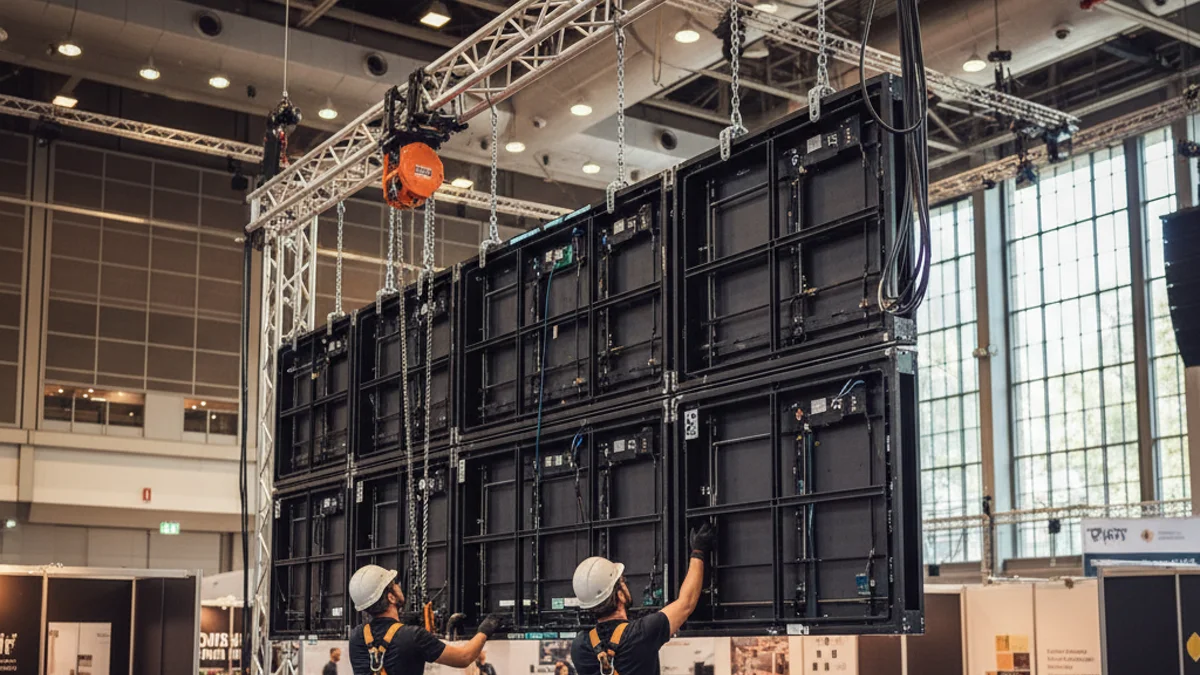
A large flown wall at the RAI is a logistics job before it is a screen job. The hall’s freight lifts, door widths and rigging rules decide how the wall is built and how long the crew needs.
A typical 8 m flown build runs across several days: one day to rig points and run power, one day to build and align the wall, and a day to de-rig after the show. Fixed move-in windows mean the crew works to a clock, and a late power connection compresses everything that follows. Ordering power and rigging together with the hall plan is what keeps the build calm.
Floor-stacked builds are faster but they consume booth floor and need a levelled base. On a tight RAI stand, the space a floor-stacked base eats is often the deciding factor between one wall and two. If the stand is small and the sightlines are shallow, a single 5 m wall read from 3 m beats two cramped ones.
Cross-Border Rentals: Bringing a Wall into the Netherlands
European buyers sometimes price a wall in Amsterdam against the same wall in Dusseldorf or Paris. The gear travels, but the labour and the venue rules do not. A wall that ships cheaply from Germany still needs Dutch crew and a Dutch load-in plan, and those are priced locally.
The practical answer is to buy the crew where the venue is. A local rental house knows the RAI’s freight-lift bookings and the Beurs van Berlage’s rigging limits; a distant supplier learns them at your expense, usually on move-in day.
Pitch, Brightness and Camera Work
On-camera content changes the spec. A camera exaggerates jagged edges and rolling flicker, so a keynote that is streamed or recorded needs a tighter pitch and a higher refresh rate than a wall read only by people in the room. That is why a broadcast-facing stage often carries P2.6 or P1.9 rather than the P3.9 that would suit the same stage for a live-only audience.
Brightness is the other lever. Indoor walls at 800 to 1,200 nits sit comfortably in a controlled hall, but a wall behind a camera often wants less brightness and more uniformity so faces do not blow out on screen. Outdoor walls go the other way, pushing past 5,000 nits to fight direct sun.
- Live-only audience: modest pitch, hall-appropriate brightness.
- Streamed or recorded: tighter pitch, higher refresh, controlled brightness.
- Mixed-use: spec for the camera, then dim the wall for the room.
The Processor and Signal Chain Explained
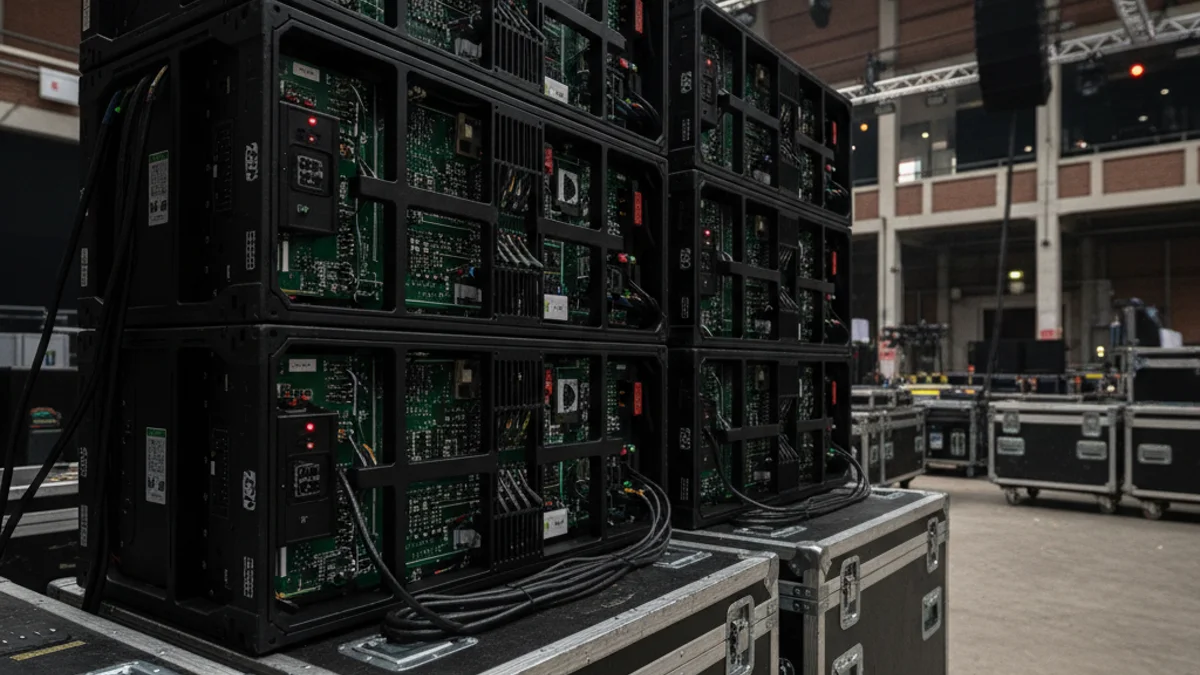
One processor drives one wall in most rentals. A Novastar-class or Brompton-class unit handles scaling, colour and the mapping between your source and the cabinets. The processor is not glamorous, but it is where a wall either looks right or looks broken.
Insist on a clean chain: a single locked source, short data runs, and a spare input. When a signal drops mid-show, it is almost always a source or cable problem rather than a failed cabinet, and a technician with a spare input fixes it in seconds.
Set-Up, Standby and De-Rig: What the Crew Days Cover
Crew time is the line most often underestimated. A build day is not interchangeable with a show day, and both are priced differently.
- Build day: rig points or truss bases, power, cabinets, alignment and a test.
- Show day: standby, content tweaks, and a reactive fix if a cabinet or input fails.
- De-rig day: strike inside the window, pack the flight cases and clear the hall.
Booking the de-rig into a fixed move-out window matters as much as the build. Overrun on move-out attracts venue charges, and those are never part of the original quote. For galas and awards, our award ceremony video wall rental page covers the stage-facing layout we use most.
Labour, Transport and Rigging: Where an Amsterdam Quote Actually Lands
On an Amsterdam job the screen is rarely the biggest line item. Three costs usually overtake it: crew, transport and rigging. Dutch crew rates for a certified LED technician typically run EUR 55-85 per hour on show calls, with a minimum call of 8-10 hours and a night or Sunday uplift of 25-50 percent. A two-day RAI Amsterdam show generally needs four crew days: build, standby, standby, de-rig.
Transport is the second surprise. At the RAI and out on the Zuidas a 40-tonne truck with a 13.6 m trailer is normal. Cross into a canal-side venue such as the Beurs van Berlage or a Westergasfabriek space and the same wall has to arrive on a 7.5-tonne vehicle or in a split load – the historic bridges and quays are weight- and length-restricted, and several inner-city venues sit in an environmental zone that excludes older diesels. Budget for a transshipment stop, a van shuttle and the extra hours that come with it.
Rigging is the third. Modern Amsterdam halls such as the RAI, Taets and AFAS are truss-friendly, but listed buildings and the older halls at the Johan Cruijff ArenA and Ziggo Dome need structural sign-off before anything hangs. If your design wants a motor hoist per metre of flown truss, budget EUR 45-90 per motor per day plus the engineering note.
Frequently Asked Questions
How much does it cost to hire a LED screen?
Hiring an LED screen in Amsterdam costs roughly €400 per day for a small indoor wall and from about €700 per day for a standard trade-show wall. Delivery, crew and spares typically add 40–60%, so budget the whole package rather than the screen alone.
How much do LED screens cost?
LED screens cost from a few hundred euros a day to hire and from several thousand euros to buy, depending on size and pitch. For a one-off event, hiring is almost always cheaper, because the owner carries the maintenance, spares and obsolescence risk.
What is a rental LED screen?
A rental LED screen is a modular video wall of 500 × 500 mm cabinets hired for a set period rather than bought. The modules lock together borderless, so the rental house can build almost any width in 0.5 m increments and take it away at the end.
How much does it cost to rent a bicycle in Amsterdam?
Renting a bicycle in Amsterdam costs about €10 to €15 per day from a city hire shop. It is not an LED question, but it is the same lesson as screen hire: daily rates fall as the rental period grows, and you pay for convenience when you book late.
Do I need a technician on site for the whole show?
Most Amsterdam exhibitors take at least half-day technical standby per show day. If your content is locked and tested, standby covers a cabinet swap or a signal reset; if you plan live edits, book a full-day technician.
Why Book Your Amsterdam LED Screen With Us
- Amsterdam-based crew who know the halls, docks and lift bookings.
- P1.9 to P4.8 cabinets in stock, plus indoor, outdoor and trailer options.
- Transparent quotes that itemise delivery, crew and spares.
- Spares and technical standby so one dead cabinet never ends your show.
- Rigging, power and content guidance before you commit.
Send us your stand plan, dates and viewing distance and we will return an itemised Amsterdam quote within one working day. Ready to price your wall? Browse our outdoor LED screen rental range, our conference video wall rental option, or the concert video wall rental page for stage work. For pitch and sightline planning, see our pixel pitch guide and how to choose the right video wall. Venue detail lives in our Amsterdam convention venues guide.
Reliable background on how these screens work is worth a read before you brief content: Wikipedia’s pages on the LED display, the video wall, display resolution, refresh rate and the nit (a brightness unit) explain the vocabulary suppliers will use with you.
